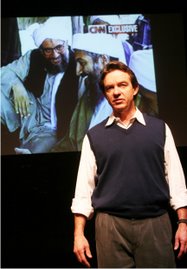
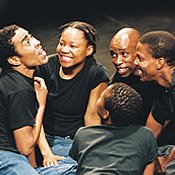
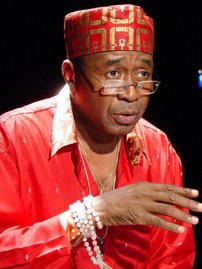
A panel on stage, Allan Buchman chatting up its members.
Amy Goodman moderates. She opens by noting that the media is the most powerful tool for awareness, a sort of kitchen table that stretches across the country and globe. And is not covering impeachment.
On the panel, Marjorie Cohn, John Nichols, and Naomi Wolf.
To Nichols, Goodman asks why the Dems want to wait for another pres. election to get rid of Bush. Nichols points out that elections are easy. Impeachment is important on its own. We can't just wait for an election; we have to send a message to all future presidents about what how is not okay to govern.
To Cohn, Goodman asks about the reasons for going to Iraq and potentially Iran. The real reason, Cohn says, Bush went to Iraq became clear just recently when we made agreements with Iraq to have troops there indefinitely - to stay in Iraq and move on to Iran. Notwithstanding the new evidence that Iran doesn't have nuclear weapons, Bush says he has not taken military action against Iran off the table.
Cohn notes that Congress does not have legal authority to start a "war of aggression," one that breaks a treaty, a war whose causes are falsified or blown out of proportion.
Cohn breaks down how impeachment works: The House votes to impeach the president; the Senate acts a court, presiding over the impeachment itself.
Nichols explains that Congress can impeach Cheney and Bush at once (I wrote "Nixon" instead of Cheney first, took a second to see it - Freud at work). But Nichols says to start with Cheney, then move up, exposing the dual criminality of the Dick and the Bush.
Naomi Wolf describes the step by which would-be dictators do their thing: They create vague internal and external threats; they create secret prisons; they create military not answerable to the people; they spy on their own citizens; they harass citizen's groups; they arbitrarily detain and release individuals (TSA for travelers, environmentalists, progressives); they target individuals (Bill Maher, Dixie Chicks, CEOs getting fire); they--oh--here it is--
I think this is so important I'm going to paste in the Wikipedia version, to reiterate:
The Ten Steps to Dictatorship
1. Invoke a terrifying internal and external enemy.
2. Create secret prisons where torture takes place.
3. Develop a thug caste or paramilitary force not answerable to citizens.
4. Set up an internal surveillance system.
5. Harass citizens' groups.
6. Engage in arbitrary detention and release.
7. Target key individuals.
8. Control the press.
9. Declare all dissent to be treason.
10. Suspend the rule of law.
Wolf points out that there was still a parliament in Italy when Mussolini took over. He talked to parliament, then he stopped talking. Then at some point later, there was no point even pretending. Bush could declare an emergency tomorrow and boot out Congress. The state is legalizing torture. We could lose democracy, de jure, at any moment. We already have, de facto (the stolen election, torture, crazy war).
Goodman reads from Wolf's The End of America: A Letter of Warning to a Young Patriot, which begins with an anecdote of a government worker blogging (!) against torture and being fired for her morals.
Cohn says Mukase won't stop waterboarding because to do so would be to admit that Bush had broken the law. Waterboarding is so obviously torture, there'd be little point admitting it had anything to do with Bush or that torture shouldn't be legal. The only option Mukase et cronies have is to stay the course.
Cohn describes how lawyers are fighting back, protesting, making some headway against the Justice Department by not backing down on Gitmo cases.
Nichols suggests the Democratic candidates should have to debate Naomi Wolf on each point - not Wolf Blitzer and Tim Russert and those who ignore the issue of impeachment.
Wolf points out that Bush terrifies so many - libertarians, anarchists, Green Party people. "On paper," Wolf says, "it's over, it's already over. The coup is over." A bill just passed criminalizing anything against Bush as terrorism. You don't need the Long Knives, says Wolf, just these scary laws. This impeachment theater could be criminal. Her book could be criminal.
Nichols is asking Congresspeople to read his book and Wolf's, to just read the articles of impeachment.
Cohn talks about the new bill again - I'm going to look this one up in a sec - and how it criminalizes thought that "advocates force," not only violence, but, say, a protest.
Wolf compares Bush & co. to the Nazis and Stalin, but conservatively, at evidence, at facts. "No one who's read my book," she says, criticizes her comparisons. She tells Cohn, who brought up the Unamerican Activities Committee in the Fifties, that Bush's plan is much more akin to Stalin's than to McCarthy's.
Goodman asks, in closing, what we can do now.
Nichols reiterates that Wexler and others have called for impeachment hearings; write and call and go visit your Congresspeople to ask them to impeach Bush and Cheney. And write and call your local media. We have to get the media involved on a much bigger level. Forget the election for one second. Impeachment is dramatically more important. The presidency had become a pack of lies.
Cohn calls for ending the war, in addition to constantly calling on our leaders to impeach Bush and Dick.
Wolf calls for impeaching and prosecuting B&C. "The only way to save this country." Word up.
Goodman talks about the FCC ending regulations that restrain a few big companies from owning all the major media. Upside, DemocracyNow! has grown quite a bit. And the internet. Don't forget the internet. Please post and repost our videos and articles; comment; send us new leads. Contact your Congresspeople. Show them the videos.
Oh, we're not done. Buchman comes on to remind us that we're going to pursue this issue all year. I think Jackon Browne is going to sing...
Showing posts with label Media. Show all posts
Showing posts with label Media. Show all posts
Sunday, December 16, 2007


Article V Panel
Denis Moynihan again moderates. Nation writer John Nichols runs on stage, fields an immediately Moynihan question: Where are we, on impeachment, right now?
Nichols said things are as good as they've ever been, and as bad. He notes that Congress is finally moving: Florida rep. Bob Wexler is holding hearings for the impeachment of Dick Cheney. GO TO HIS WEBSITE, http://wexlerwantshearings.com/, and sing up. This is the best way to get the ball rolling, right now.
Holtzman puts the brakes on Nichols' and Wexler's vision by noting that, if the vision is partisan - if it consists of "Democrats hate Bush" - then it will fail. We need a bipartisan approach. "Let's go back to Watergate," she says. I wince. But her point is we don't need hearings. Watergate started with evidence. Bipartisan call for evidence.
Seems to me that we need something to happen, whether it's thanks to Wexler or not.
Cohn points out we need an independent prosecutor, a special investigator.
Nichols says Wexler and others have just now given us the opening to impeach Bush.
Holtzman and Nichols are getting into it a bit over the procedural differences between special prosecution and Congressional hearings. (Everyone agrees Bush should be impeached somehow, ASAP.)
Lindorff says that Republicans need to be shown that it was dumb and dangerous not to impeach Bush - that the next president probably will be a Democrat and almost definitely will not give up any power whatsoever that Bush gave the presidency.
Horton agrees. "This can only be checked effectively by the impeachment process."
Nichols: Impeachment, seriously pursued, usually succeeds in forcing leaders to step back from the brink. I love this idea. We need to impeach the sons of donkeys not simply because Hillary might win and continue to use the powers d'Bush, but because Bush and Hillary and the Republicans and Democrats need to be told, by the American people, by the voices of reason in Congress, that it is illegal to spy on Americans, to torture prisoners, to utterly ignore the poor of the South in times of crisis, to ignore laws, to start wars.
Holtzman calls it "inertia." We have to press [the Congress]. (She goes back to Watergate with each answer, each time losing some clarity on the matter: Bushiraqtorturegate simply isn't Watergate. This is a new era. Bush is a new terror. I'm sure Holtzman's suggestions are apt and her ideas useful as to how we can oust Bush. But if Bob Wexler gets it done his own way, props to Bob Wexler.)
Nichols tells us to contact our local Congresspeople and tell them to impeach Bush. Particularly Jerrold Nadler. Please do this.
Question from the audience that becomes an angry litany of Buhs's crimes.
New question asks what else we can do.
Nichols says the public is just as angry at Bush as they were at Nixon; the media has changed, however, and we have seen virtually nothing about impeachment on TV.
Cohn notes that Bush is lying about Iran, aggressive against Iran, and not going to be phased by news that Iran doesn't necessarily have nukes. Cohn says getting out of Iraq and stopping Bush before he can go into Iran should be our number one priorities.
Audience member asks/tells something amounting to, "people all over New York want to impeach Bush." Panel agrees; people everywhere want to impeach him.
Holtzman goes back to Watergate. General discussion of lack of media attention to impeachment. Where's the New York Times on this?
Horton (notice his sweet blog) says polls show people, when asked if Bush has committed serious crimes, over 60% of those polled say yes. In Jackson, Mississippi, prosperous white businessmen asked Horton why nobody was impeaching Bush's ass?
Nichols says now is the time to talk to Republicans about impeachment; they are ready; they are either sick of Bush or afraid of giving Bush-powers to Hillary.
Nichols says we can't let the upcoming election become any excuse for not holding Bush accountable.
Horton says for the last several years, the Republicans have been velociraptors; the Democrats, invertebrates. Democracts aren't challenging bad Republican laws. (Well, this has a lot to do with our two-party/arguably-one-class-based-party system. I yearn for a multi-party system.)
Lindorff tells us how Bush took over science programs to manufacture evidence for war against Iraq.
Holtzman reminds us that impeachment is a democratic process envisioned by the framers to be used in circumstances just such as these. We have the time. This will not divide the country; this will unify the country. Rule of law is more important than any one president or party.
Cohn says we have to elect a Democrat in 2008. Bush has done the most dangerous thing, aside from Iraq, by stacking the Supreme Court. Please vote for the Democrat.
And we're done with the articles of impeachment. I for one am convinced - my suspicions confirmed - that we need to get Bush and Cheney out.
Rebel Voices up next, then the big closing concert at 7:30.
Nichols said things are as good as they've ever been, and as bad. He notes that Congress is finally moving: Florida rep. Bob Wexler is holding hearings for the impeachment of Dick Cheney. GO TO HIS WEBSITE, http://wexlerwantshearings.com/, and sing up. This is the best way to get the ball rolling, right now.
Holtzman puts the brakes on Nichols' and Wexler's vision by noting that, if the vision is partisan - if it consists of "Democrats hate Bush" - then it will fail. We need a bipartisan approach. "Let's go back to Watergate," she says. I wince. But her point is we don't need hearings. Watergate started with evidence. Bipartisan call for evidence.
Seems to me that we need something to happen, whether it's thanks to Wexler or not.
Cohn points out we need an independent prosecutor, a special investigator.
Nichols says Wexler and others have just now given us the opening to impeach Bush.
Holtzman and Nichols are getting into it a bit over the procedural differences between special prosecution and Congressional hearings. (Everyone agrees Bush should be impeached somehow, ASAP.)
Lindorff says that Republicans need to be shown that it was dumb and dangerous not to impeach Bush - that the next president probably will be a Democrat and almost definitely will not give up any power whatsoever that Bush gave the presidency.
Horton agrees. "This can only be checked effectively by the impeachment process."
Nichols: Impeachment, seriously pursued, usually succeeds in forcing leaders to step back from the brink. I love this idea. We need to impeach the sons of donkeys not simply because Hillary might win and continue to use the powers d'Bush, but because Bush and Hillary and the Republicans and Democrats need to be told, by the American people, by the voices of reason in Congress, that it is illegal to spy on Americans, to torture prisoners, to utterly ignore the poor of the South in times of crisis, to ignore laws, to start wars.
Holtzman calls it "inertia." We have to press [the Congress]. (She goes back to Watergate with each answer, each time losing some clarity on the matter: Bushiraqtorturegate simply isn't Watergate. This is a new era. Bush is a new terror. I'm sure Holtzman's suggestions are apt and her ideas useful as to how we can oust Bush. But if Bob Wexler gets it done his own way, props to Bob Wexler.)
Nichols tells us to contact our local Congresspeople and tell them to impeach Bush. Particularly Jerrold Nadler. Please do this.
Question from the audience that becomes an angry litany of Buhs's crimes.
New question asks what else we can do.
Nichols says the public is just as angry at Bush as they were at Nixon; the media has changed, however, and we have seen virtually nothing about impeachment on TV.
Cohn notes that Bush is lying about Iran, aggressive against Iran, and not going to be phased by news that Iran doesn't necessarily have nukes. Cohn says getting out of Iraq and stopping Bush before he can go into Iran should be our number one priorities.
Audience member asks/tells something amounting to, "people all over New York want to impeach Bush." Panel agrees; people everywhere want to impeach him.
Holtzman goes back to Watergate. General discussion of lack of media attention to impeachment. Where's the New York Times on this?
Horton (notice his sweet blog) says polls show people, when asked if Bush has committed serious crimes, over 60% of those polled say yes. In Jackson, Mississippi, prosperous white businessmen asked Horton why nobody was impeaching Bush's ass?
Nichols says now is the time to talk to Republicans about impeachment; they are ready; they are either sick of Bush or afraid of giving Bush-powers to Hillary.
Nichols says we can't let the upcoming election become any excuse for not holding Bush accountable.
Horton says for the last several years, the Republicans have been velociraptors; the Democrats, invertebrates. Democracts aren't challenging bad Republican laws. (Well, this has a lot to do with our two-party/arguably-one-class-based-party system. I yearn for a multi-party system.)
Lindorff tells us how Bush took over science programs to manufacture evidence for war against Iraq.
Holtzman reminds us that impeachment is a democratic process envisioned by the framers to be used in circumstances just such as these. We have the time. This will not divide the country; this will unify the country. Rule of law is more important than any one president or party.
Cohn says we have to elect a Democrat in 2008. Bush has done the most dangerous thing, aside from Iraq, by stacking the Supreme Court. Please vote for the Democrat.
And we're done with the articles of impeachment. I for one am convinced - my suspicions confirmed - that we need to get Bush and Cheney out.
Rebel Voices up next, then the big closing concert at 7:30.
Sunday, November 18, 2007
O Christopher Hitchens!
Seriously, he gives we of little (or zero) faith a bad name. Or several bad names, probably.
Check out his latest shenanigans...
and some thoughts on said shenanigans.
We're going to post more on this blog in the future. We promise.
Check out his latest shenanigans...
and some thoughts on said shenanigans.
We're going to post more on this blog in the future. We promise.
Monday, April 30, 2007
Did Oldboy "Inspire" Me To Feed My Cat This Morning?
Oldboy is not the problem. Hostel II--as poor an example of art or taste as you may ever see--is not the problem. Movies, books, television shows, and Marilyn Manson are not turning America's little ones into gun-toting psychopaths.
From Michael Cieply's "After Virginia Tech, Testing Limits of Movie Violence," today's NYTimes:
We know some commentators will always say some funny stuff about media and violence.
But the New York Times and its staff should better understand and, more to the point, since I'm sure they do understand, better represent the origins of art that deals with bloodshed. As I wrote earlier, there have always been works of art about violence because there has always been violence. Old Boy does not advocate, prescribe, inspire, or even really comment on violence. It is a movie about revenge (and incest, and potstickers, and eating raw octopus--again, a great movie). So is Kill Bill. So are many other movies--good, bad, and stupid.
We hope the Times more carefully addresses artistic violence in the future. For my part, I'm not going to see Hostel II, but not because I believe it will inspire me or someone I know to go on a shooting rampage. I'm not going to see it because it's going to be poorly written, badly acted, and probably more than a trifle boring.
(Kill Bill Vol. 3, on the other hand...)
From Michael Cieply's "After Virginia Tech, Testing Limits of Movie Violence," today's NYTimes:
Given [Hostel II's] subject matter and the marketing campaign that has already come with it — posters featuring a woman’s severed head and other grisly images are now scattered on the Web — the Lionsgate film is emerging as a test of continued audience enthusiasm for such onscreen brutality, which some commentators have connected with the Blacksburg gunman Seung-Hui Cho’s video and its possible echoes of the Korean revenge film “Old Boy.”
“What might have been traditionally acceptable exploitation in one period can be seen as stupendously bad taste in another,” said Martin Kaplan, director of the Norman Lear Center at the University of Southern California, which examines the links among entertainment, commerce and society.
We know some commentators will always say some funny stuff about media and violence.
But the New York Times and its staff should better understand and, more to the point, since I'm sure they do understand, better represent the origins of art that deals with bloodshed. As I wrote earlier, there have always been works of art about violence because there has always been violence. Old Boy does not advocate, prescribe, inspire, or even really comment on violence. It is a movie about revenge (and incest, and potstickers, and eating raw octopus--again, a great movie). So is Kill Bill. So are many other movies--good, bad, and stupid.
We hope the Times more carefully addresses artistic violence in the future. For my part, I'm not going to see Hostel II, but not because I believe it will inspire me or someone I know to go on a shooting rampage. I'm not going to see it because it's going to be poorly written, badly acted, and probably more than a trifle boring.
(Kill Bill Vol. 3, on the other hand...)
Monday, April 23, 2007
Points Missed Amid Other, Stupider Points
From A. O. Scott's "Drawing a Line From Movie to Murder" in today's Times:
WTF?
Scott goes on, in his toothless, meandering way, to down-play the role of movie violence in "inspiring" shootings like the one at Virginia Tech.
But an over-arching note of connection between movies and violence persists.
It is as if Oldboy--a wonderful retelling of The Count Of Monte Cristo by one of the world's great living directors, Chan-Woo Park--could really somehow be blamed for the actions of a single confused young man.
Oldboy, for the record, isn't about shooting schools, or shooting anyone at all. It's about revenge. (Well, and incest.) Its hero uses, among other weapons, a hammer. It's mythic, hyperbolic, beautifully made, and a little ridiculous (with intention). It is not any more violent than the Iliad, or than The Red Badge Of Courage. If the same confused young man who saw Oldboy had been born one hundred years ago, perhaps he would have frequently referenced Poe, or H. G. Wells, or Melville instead of C.-W. Park.
Many people, in fact, abuse metaphors and misappropriate symbols every day. When I say "I was as sad as Gilgamesh when my first cat, Oscar, died," I know that I was not really as sad as that mythic Babylonian king was when his best friend died. I know that the two events are only related symbolically. I am simply very sad. Did Gilgamesh "inspire" me to be sad?
Ask yourself: Did a movie about revenge make the VA Tech killer take revenge? (On whom was he taking revenge? Why?) How could a popular movie, a movie I and many of my friends have seen several times, have "inspired" anything so epic? Had it not existed, would perhaps the Iliad--a tale all about revenge, insane, civilization-breaking revenge--have "inspired" the same actions?
We walk a very slippery, stupid slope when we conflate metaphors with the things they describe. The Deconstructionists pointed this out often, and I think it's worth remembering now. Oldboy no more "inspires" violence than the Iliad, or than Teenage Mutant Ninja Turtles. Art, it has been known in all cultures throughout all times, is cathartic. It essentially fights against violence by allowing us to live the arc of anger, release, and forgiveness without actually having to, say, invade Ilium, or to defeat Shredder.
Stupid people will always misuse art for evil purposes (see Germany, the late 1930s, or listen to Fifty Cent), and other stupid people--not necessarily Mr. Scott of the Times, but many people who read his piece today--will misuse the fears of the masses against art.
Because we cannot control all the information that our children absorb every day, we must teach them to discriminate between the true and the untrue, the loving and the dangerous. We must explain why Achilles fought in the Trojan War, why we root for Donatello to dismantle Shredder's Terrordrome, and why the titular Oldboy is not a model of morality, though neither is he a totally unsympathetic murderer.
Oldboy is like all of us: He would rather not get in a fight... until he's pushed "to the limit." What pushed the VA Tech shooter past his limit, what made him feel akin to Oldboy (who, like the Count of Monte Cristo, had been truly and horribly wronged--had been given a clearer grounds for revenge than the young man who murdered his classmates), I do not pretend to know.
But I don't think we should blame--or even hint around blaming--artists Mr. Park.
“Oldboy,” Stephen Hunter wrote in The Washington Post on Friday, “must feature prominently in the discussion” of Mr. Cho’s possible motivations, “even if no one has yet confirmed that Cho saw it.” If he did, Mr. Hunter notes, “he would have passed on the subtitles and listened to it in his native language” and perhaps developed a feeling of kinship with its persecuted, paranoid hero.
WTF?
Scott goes on, in his toothless, meandering way, to down-play the role of movie violence in "inspiring" shootings like the one at Virginia Tech.
But an over-arching note of connection between movies and violence persists.
It is as if Oldboy--a wonderful retelling of The Count Of Monte Cristo by one of the world's great living directors, Chan-Woo Park--could really somehow be blamed for the actions of a single confused young man.
Oldboy, for the record, isn't about shooting schools, or shooting anyone at all. It's about revenge. (Well, and incest.) Its hero uses, among other weapons, a hammer. It's mythic, hyperbolic, beautifully made, and a little ridiculous (with intention). It is not any more violent than the Iliad, or than The Red Badge Of Courage. If the same confused young man who saw Oldboy had been born one hundred years ago, perhaps he would have frequently referenced Poe, or H. G. Wells, or Melville instead of C.-W. Park.
Many people, in fact, abuse metaphors and misappropriate symbols every day. When I say "I was as sad as Gilgamesh when my first cat, Oscar, died," I know that I was not really as sad as that mythic Babylonian king was when his best friend died. I know that the two events are only related symbolically. I am simply very sad. Did Gilgamesh "inspire" me to be sad?
Ask yourself: Did a movie about revenge make the VA Tech killer take revenge? (On whom was he taking revenge? Why?) How could a popular movie, a movie I and many of my friends have seen several times, have "inspired" anything so epic? Had it not existed, would perhaps the Iliad--a tale all about revenge, insane, civilization-breaking revenge--have "inspired" the same actions?
We walk a very slippery, stupid slope when we conflate metaphors with the things they describe. The Deconstructionists pointed this out often, and I think it's worth remembering now. Oldboy no more "inspires" violence than the Iliad, or than Teenage Mutant Ninja Turtles. Art, it has been known in all cultures throughout all times, is cathartic. It essentially fights against violence by allowing us to live the arc of anger, release, and forgiveness without actually having to, say, invade Ilium, or to defeat Shredder.
Stupid people will always misuse art for evil purposes (see Germany, the late 1930s, or listen to Fifty Cent), and other stupid people--not necessarily Mr. Scott of the Times, but many people who read his piece today--will misuse the fears of the masses against art.
Because we cannot control all the information that our children absorb every day, we must teach them to discriminate between the true and the untrue, the loving and the dangerous. We must explain why Achilles fought in the Trojan War, why we root for Donatello to dismantle Shredder's Terrordrome, and why the titular Oldboy is not a model of morality, though neither is he a totally unsympathetic murderer.
Oldboy is like all of us: He would rather not get in a fight... until he's pushed "to the limit." What pushed the VA Tech shooter past his limit, what made him feel akin to Oldboy (who, like the Count of Monte Cristo, had been truly and horribly wronged--had been given a clearer grounds for revenge than the young man who murdered his classmates), I do not pretend to know.
But I don't think we should blame--or even hint around blaming--artists Mr. Park.
Subscribe to:
Comments (Atom)