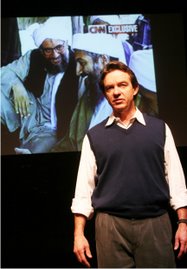
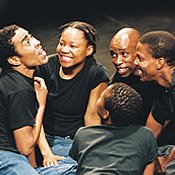
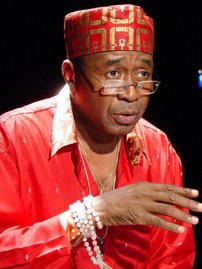
...reads a poem, shortish, involving a beer. I'll find it (I hope) and post in a sec.
Frank Bidart reads "To the Republic," a poem about the Civil War read on AQoI's first night.
Showing posts with label Poetry. Show all posts
Showing posts with label Poetry. Show all posts
Sunday, December 16, 2007


Kathleen Chalfant and Darryl Larson
...takes the stage, dressed in black, to read "Pity the Nation." Found a book by that title in addition to the poem.
Larson reads a Peter Matheson piece about the impact Bush and Cheney have had on our environment: They've cut programs to find alternatives to oil; they've invaded countries for oil; they've not enforced environmental regulations. These crimes, like those committed to steal the elections in 2000 and 2004, are not included in our articles of impeachment, nor those of Wexler nor Kucinich. But That doesn't make them less grave, just less easy to prosecute.
Larson points out that all the money in the world won't save the Bushes and Cheneys of two hundred years from now from the scorching sun and the undrinkable water. Booyakah, future-Bushes. Sadly. Booyakah.
Larson reads a Peter Matheson piece about the impact Bush and Cheney have had on our environment: They've cut programs to find alternatives to oil; they've invaded countries for oil; they've not enforced environmental regulations. These crimes, like those committed to steal the elections in 2000 and 2004, are not included in our articles of impeachment, nor those of Wexler nor Kucinich. But That doesn't make them less grave, just less easy to prosecute.
Larson points out that all the money in the world won't save the Bushes and Cheneys of two hundred years from now from the scorching sun and the undrinkable water. Booyakah, future-Bushes. Sadly. Booyakah.
Ned Eisenberg and J.T.
Ned Eisenberg reads "Bounden Duty," one of my favorite poems by the maestro of weird, James Tate.
Basically, the president asks the narrator, a farmer, to act normal. It's hard to act normal. The narrator's thought process devolves into paranoia. Abrupt, mysterious ending.
Basically, the president asks the narrator, a farmer, to act normal. It's hard to act normal. The narrator's thought process devolves into paranoia. Abrupt, mysterious ending.
Aasif Mandvi
"I wrote this poem," Daily Show alum Mandvi says, "because I'm afraid of Americans."
The poem begins with the image of a handsome white man on TV telling a young Aasif Mandvi all that he knows about the world. They're best buddies.
Then the white man yells, "Jiiiiihaaad!" "His mouth is open now like a whale..."
"What is this word?" The poem is a fable. The man and Mandvi are friends until the white man yells "jihad."
The poem is frenetic, hypnotizing. The white man eats everything. Mandvi and his mother crouch and hide from him as his mouth engulfs everything. What did his grandfather do to make the white man mad? "It's not your dada, it's not your grandpa," she tells him. He's happy, for a moment. Suffice to stay, it doesn't stay happy.
The poem begins with the image of a handsome white man on TV telling a young Aasif Mandvi all that he knows about the world. They're best buddies.
Then the white man yells, "Jiiiiihaaad!" "His mouth is open now like a whale..."
"What is this word?" The poem is a fable. The man and Mandvi are friends until the white man yells "jihad."
The poem is frenetic, hypnotizing. The white man eats everything. Mandvi and his mother crouch and hide from him as his mouth engulfs everything. What did his grandfather do to make the white man mad? "It's not your dada, it's not your grandpa," she tells him. He's happy, for a moment. Suffice to stay, it doesn't stay happy.
John Nichols, Thomas Jefferson, and a Poem
...gives a rousing call-to-arms regarding impeachment - a perfect way to enter back into the subject. Possibly the best speech of the series (yet).
Bower, as T.Jeff., takes the stage and reads some dry but appropriately deep material, from the (former) T.Jeff.
Then a long poem written from the perspective of a literal fly on the wall during a Senate Armed Services Committee meeting.
Bower, as T.Jeff., takes the stage and reads some dry but appropriately deep material, from the (former) T.Jeff.
Then a long poem written from the perspective of a literal fly on the wall during a Senate Armed Services Committee meeting.
Monday, December 10, 2007
Sunday, December 9, 2007
Fear and Interpretation
Thinking back on the reading tonight, it strikes me how much of the detainees' poetry seems to stem from confusion as often as outrage. Again and again, Allah is invoked not bitterly, but almost wistfully: The poet doesn't need to ask Allah to destroy the unjust; the poet wants God to explain to his family that the disorder created by those who fight "a war for peace" will be made ordered again.
This leads me to an article by Akbar Ganji on women's rights in Iran, published in the most recent Boston Review.
Ganji's argument is against the unequal treatment of women in modern Iran, which is worth several posts of its own. But he touches upon a bigger, more overarching point about Islam and rationality: Various important Muslim thinkers, from the Ayatollah Khomeini way back to al-Ghazali - thinkers both conservative and radical - have pointed out that the most important aspect of Islam isn't the following of any specific rule whatsoever, it's just belief in the merciful God.
Said another way, generalized even further out from Islam, the most important aspect of a religion - of any ideal - is the spirit behind it, not the specific methods by which that spirit is manifested in the world.
Take America's war on terror. Like George Bush and the wardens of Guantánamo, I am against Jihadi suicide bombers, against Osama Bin-Laden, against kidnappers. The spirit - protect life - is the same. But the methods differ. Progressives refer to the law, to rational arguments against torture, while Bush and his cronies maintain a strict, Jihadi-like focus on a ghostly version of efficiency. If they think torture is efficient, torture is in, even if it violates the spirit itself. The methods get ahead of the reason behind them, the reason for using them - the methods eat their own collective tail.
Thinking about the dichotomy between spirit (compassion, mercy, reason) and method (torture, kidnapping, secrecy, willful ignoring of law, lack of respect for others' traditions), the methodological links between the Jihadis and the anti-Jihadis blur the two categories. An Orwellian, frightening state of mind.
This leads me to an article by Akbar Ganji on women's rights in Iran, published in the most recent Boston Review.
Ganji's argument is against the unequal treatment of women in modern Iran, which is worth several posts of its own. But he touches upon a bigger, more overarching point about Islam and rationality: Various important Muslim thinkers, from the Ayatollah Khomeini way back to al-Ghazali - thinkers both conservative and radical - have pointed out that the most important aspect of Islam isn't the following of any specific rule whatsoever, it's just belief in the merciful God.
Said another way, generalized even further out from Islam, the most important aspect of a religion - of any ideal - is the spirit behind it, not the specific methods by which that spirit is manifested in the world.
Take America's war on terror. Like George Bush and the wardens of Guantánamo, I am against Jihadi suicide bombers, against Osama Bin-Laden, against kidnappers. The spirit - protect life - is the same. But the methods differ. Progressives refer to the law, to rational arguments against torture, while Bush and his cronies maintain a strict, Jihadi-like focus on a ghostly version of efficiency. If they think torture is efficient, torture is in, even if it violates the spirit itself. The methods get ahead of the reason behind them, the reason for using them - the methods eat their own collective tail.
Thinking about the dichotomy between spirit (compassion, mercy, reason) and method (torture, kidnapping, secrecy, willful ignoring of law, lack of respect for others' traditions), the methodological links between the Jihadis and the anti-Jihadis blur the two categories. An Orwellian, frightening state of mind.
Closing with Buchman
Lynn R. reads of a man who confessed to trying to kill Osama Bin-Laden. The Taliban caught him. The U.S. found him and promised to release him. Then they sent him to Guantánamo. He was there for some time, then released two years ago. His poem is very, very short.
Now the Redgraves stand to bow. The reading is over? Wow, that was fast. Good - well-produced - but fast.
The applause goes on and on, not abating for a full minute and a half.
Allan Buchman takes the stage again and announces that Culture Project is in the process of producing an event for the United Nations, for Human Rights Day (I think?). December 10, 2008 - save the date.
And... we're done. Gotta get that book.
Now the Redgraves stand to bow. The reading is over? Wow, that was fast. Good - well-produced - but fast.
The applause goes on and on, not abating for a full minute and a half.
Allan Buchman takes the stage again and announces that Culture Project is in the process of producing an event for the United Nations, for Human Rights Day (I think?). December 10, 2008 - save the date.
And... we're done. Gotta get that book.
Guantánamo Poetry, read by the Redgraves
Corin Redgrave reads "They Fight For Peace," by a poet who's name I can't type quickly or accurately enough.
Very short, abstract, powerful poem.
Lynn Redgrave takes the stage and reads a short history of the poet's life. The poet, Ameer, a Saudi, was detained because he worked in Afghanistan for a charity. He is a leader at Gitmo. Just after a Grievance Commission was formed, the government disbanded it, put Ameer in solitary confinement, and is shipping him off to Saudi Arabia, where he will be held in a secret prison and almost certainly killed.
***
Abdul Aziz, last name withheld, from Riyadh, S.A., wrote "O Prison Darkness."
"We love the darkness
For after the dark hours of the night, pride will rise.
...
We know, God has a design.
...
The morning is about to break forth."
He also wrote, "I Shall Not Complain," an exhortation to Allah (always translated God, I suppose to make it more marketable?) to grant him patience; he will complain to none but God.
***
Jemma Redgrave speaks of a poet named Dossari, who has tried to kill himself twelve times, sometimes via multiple methods at once. He appears in Inside the Wire.
Jemma R. reads "Death Poem," a very strong work asking everyone to watch the poet die ("at the hands of the protectors of peace"). (See an earlier post for full text.)
***
Lynn R. speaks of Dost (sp? all of these sp?), an author of many, many books, a known poet and scholar. He was released, wrote a book detailing his detention at Gitmo, and was then re-arrested by Pakistani officials. He as not been heard from since.
A poem asking why he is deprived of the love of his father. "I," the poet syas, "continue to beat with life... I know a greater freedom."
Cup Poem #1
What kind of spring is this
where there are no flowers
and the air is filled with a miserable smell?
"They Cannot Help"
"Consider what might compel a man to kill himself, or another?"
***
Jemma R. reads of a young man who was hung by his wrists and beaten by the Pakistanis. He was overjoyed to be handed to the U.S. He was stripped and beaten by the U.S., too. He was one of the first round of "enemy combatants."
"This Is My Life," I think is the name of the first poem. It details what happened to him: He came to Pakistan (from Chad) to pursue an education (to learn about information technology and English). He was arrested leaving a mosque; he was not allowed to use the bathroom during a sixteen-hour trip to prison. "We saw such insults from them." The prisoners were beaten and insulted, kept drunk and rich (by the Americans?). "They carried us afterwards to Cuba, because it is an afflicted isle. Their war is against Islam, and justice."
Talk about bad P.R. I mean, if Bush's regime beats up every captured Muslim, of course the other non-captured Muslims are going to hate Bush (and thus you and me - he's our leader).
***
Corin R. loudly reads of a man "Humiliated in the Shackles," writing a letter in his head to his son as he listens to the birds outside his cell, alive, free. He is offered money and land and freedom if he betrays "other" al-Qaeda members. "America - you ride on the backs of orphans and terrorize them daily," Corin/the poet yell. He directs his grievances to Allah and asks his son to be strong, though he himself is humiliated. "How can I write? My soul is like a roiling sea. I am captive, but the crimes are my captors'."
(One feels these poems are going to take on a perhaps unwelcome degree of similarity as they concatenate...)
***
Vanessa R. reads of a man who lost both his legs due to American bombings, not even at the same time. He has been forced to walk at Gitmo on prosthetic limbs held together with duct-tape.
"To My Father"
"Two years have passed in faraway prisons
Two years my eyes untouched by cold" [or kohl?]
Forced confession, defense of honor that needs no apology. Deal-making - "if all Arabs were to sell their faith, I would not sell mine."
***
Corin R. reads of Hassan, a prolific poet taken in Pakistan while studying at a university. He remains at Gitmo, though the U.S. government does not allege that he has participated in any violence whatsoever.
"The Truth"
Inscribe your letters in laurel trees
from the cave all the way to the city of the Chosen
...
Are these lights that I see real?
The Devil leads them (Americans) around in the darkness; they have exchanged piety for cheap commodity. Will you get up and question events?
Illusions soar all around...
(The blog itself necessarily grows more poetic as the scraps well up from Corin's majestic voice - I recommend readers watch the performances on Blip [thanks to the Kunstlers and crew] tomorrow.
These poems are somewhat insular and melodramatic, moreso than other Arabic poems I've read. They are almost all addressed to Allah and speak in vague terms of justice and injustice. Some of this rally-speak is very powerful; the shorter poems, in particular, stick to specifics and turn very clear arguments against the logic of torture - with chilling, image-driven specifics. Their sadness is overwhelming and infectious.)
***
Lynn R. reads about Kabir, a poet detained primarily because he was caught wearing a Casio watch, a brand favored by terrorists (according to the U.S. government?). His poem, "Is It True?," asks if the grass still grows, if he will ever leave prison and see his wife and children again.
***
Jemma R. reads of a Yemeni, Mohammed, a religious teacher. He saw a Qur'an being thrown into a barrel of human waste in prison. "I Am Sorry, My Brother."
***
Corin R. reads of Akhmed, a man who studied at a college in the U.S. and went home after a bad break-up. He was detained, help for years in Guantánamo, then released, November, 2005.
"My Heart Was Wounded By The Strangeness"
Do not blame the poet who comes to your land inspired, arranging rhymes
...
O brother... If you blame yourself, my poem will appease you
...
I will offer advice from pure cordiality.
A quiet poem of fatalistic but not unhappy acceptance, an exhortation to be generous, to forgive. The poem's great power comes from its dwelling on separation (from the brother), not on the daily horrors of imprisonment (though that route works in so many other of these poems).
***
Vanessa R. reads of Ibrahim, a religious scholar and candidate for judgeship who was captured and sold to the United States. When asked why he should be released, he replid: "In the world of international courts, the person is innocent until proven guilty. Why, here, is the person guilty until proven innocent?" His poem asks a lot about Cuba, how Cuba could help the U.S. "What have you gained?" Poetry...
(Here I break to post...)
Very short, abstract, powerful poem.
Lynn Redgrave takes the stage and reads a short history of the poet's life. The poet, Ameer, a Saudi, was detained because he worked in Afghanistan for a charity. He is a leader at Gitmo. Just after a Grievance Commission was formed, the government disbanded it, put Ameer in solitary confinement, and is shipping him off to Saudi Arabia, where he will be held in a secret prison and almost certainly killed.
***
Abdul Aziz, last name withheld, from Riyadh, S.A., wrote "O Prison Darkness."
"We love the darkness
For after the dark hours of the night, pride will rise.
...
We know, God has a design.
...
The morning is about to break forth."
He also wrote, "I Shall Not Complain," an exhortation to Allah (always translated God, I suppose to make it more marketable?) to grant him patience; he will complain to none but God.
***
Jemma Redgrave speaks of a poet named Dossari, who has tried to kill himself twelve times, sometimes via multiple methods at once. He appears in Inside the Wire.
Jemma R. reads "Death Poem," a very strong work asking everyone to watch the poet die ("at the hands of the protectors of peace"). (See an earlier post for full text.)
***
Lynn R. speaks of Dost (sp? all of these sp?), an author of many, many books, a known poet and scholar. He was released, wrote a book detailing his detention at Gitmo, and was then re-arrested by Pakistani officials. He as not been heard from since.
A poem asking why he is deprived of the love of his father. "I," the poet syas, "continue to beat with life... I know a greater freedom."
Cup Poem #1
What kind of spring is this
where there are no flowers
and the air is filled with a miserable smell?
"They Cannot Help"
"Consider what might compel a man to kill himself, or another?"
***
Jemma R. reads of a young man who was hung by his wrists and beaten by the Pakistanis. He was overjoyed to be handed to the U.S. He was stripped and beaten by the U.S., too. He was one of the first round of "enemy combatants."
"This Is My Life," I think is the name of the first poem. It details what happened to him: He came to Pakistan (from Chad) to pursue an education (to learn about information technology and English). He was arrested leaving a mosque; he was not allowed to use the bathroom during a sixteen-hour trip to prison. "We saw such insults from them." The prisoners were beaten and insulted, kept drunk and rich (by the Americans?). "They carried us afterwards to Cuba, because it is an afflicted isle. Their war is against Islam, and justice."
Talk about bad P.R. I mean, if Bush's regime beats up every captured Muslim, of course the other non-captured Muslims are going to hate Bush (and thus you and me - he's our leader).
***
Corin R. loudly reads of a man "Humiliated in the Shackles," writing a letter in his head to his son as he listens to the birds outside his cell, alive, free. He is offered money and land and freedom if he betrays "other" al-Qaeda members. "America - you ride on the backs of orphans and terrorize them daily," Corin/the poet yell. He directs his grievances to Allah and asks his son to be strong, though he himself is humiliated. "How can I write? My soul is like a roiling sea. I am captive, but the crimes are my captors'."
(One feels these poems are going to take on a perhaps unwelcome degree of similarity as they concatenate...)
***
Vanessa R. reads of a man who lost both his legs due to American bombings, not even at the same time. He has been forced to walk at Gitmo on prosthetic limbs held together with duct-tape.
"To My Father"
"Two years have passed in faraway prisons
Two years my eyes untouched by cold" [or kohl?]
Forced confession, defense of honor that needs no apology. Deal-making - "if all Arabs were to sell their faith, I would not sell mine."
***
Corin R. reads of Hassan, a prolific poet taken in Pakistan while studying at a university. He remains at Gitmo, though the U.S. government does not allege that he has participated in any violence whatsoever.
"The Truth"
Inscribe your letters in laurel trees
from the cave all the way to the city of the Chosen
...
Are these lights that I see real?
The Devil leads them (Americans) around in the darkness; they have exchanged piety for cheap commodity. Will you get up and question events?
Illusions soar all around...
(The blog itself necessarily grows more poetic as the scraps well up from Corin's majestic voice - I recommend readers watch the performances on Blip [thanks to the Kunstlers and crew] tomorrow.
These poems are somewhat insular and melodramatic, moreso than other Arabic poems I've read. They are almost all addressed to Allah and speak in vague terms of justice and injustice. Some of this rally-speak is very powerful; the shorter poems, in particular, stick to specifics and turn very clear arguments against the logic of torture - with chilling, image-driven specifics. Their sadness is overwhelming and infectious.)
***
Lynn R. reads about Kabir, a poet detained primarily because he was caught wearing a Casio watch, a brand favored by terrorists (according to the U.S. government?). His poem, "Is It True?," asks if the grass still grows, if he will ever leave prison and see his wife and children again.
***
Jemma R. reads of a Yemeni, Mohammed, a religious teacher. He saw a Qur'an being thrown into a barrel of human waste in prison. "I Am Sorry, My Brother."
***
Corin R. reads of Akhmed, a man who studied at a college in the U.S. and went home after a bad break-up. He was detained, help for years in Guantánamo, then released, November, 2005.
"My Heart Was Wounded By The Strangeness"
Do not blame the poet who comes to your land inspired, arranging rhymes
...
O brother... If you blame yourself, my poem will appease you
...
I will offer advice from pure cordiality.
A quiet poem of fatalistic but not unhappy acceptance, an exhortation to be generous, to forgive. The poem's great power comes from its dwelling on separation (from the brother), not on the daily horrors of imprisonment (though that route works in so many other of these poems).
***
Vanessa R. reads of Ibrahim, a religious scholar and candidate for judgeship who was captured and sold to the United States. When asked why he should be released, he replid: "In the world of international courts, the person is innocent until proven guilty. Why, here, is the person guilty until proven innocent?" His poem asks a lot about Cuba, how Cuba could help the U.S. "What have you gained?" Poetry...
(Here I break to post...)
Vanessa Redgrave
...abruptly takes to the mic and recounts growing up in England during World War II. She found a book demonstrating egregious torture against prisoners in Germany. She knew, even as a little girl, why England was at war: To stop torture. To end concentration camps.
She reads a definition of torture, discusses the recent questions of what is torture, what should be allowed, what prohibited. She recommends Condie Rice reread Gulag Archipelago.
We are on the eve of international Human Rights Day. She raises the question, is extremist Jihadi terrorism today somehow worse than the terrorism of Hitler and Stalin? The idea behind the laws banning torture - laws formerly endorsed by the U.S., still endorsed, at least in theory, by every other enlightened democracy - were created during and just after WWII. The idea was that nothing, absolutely nothing should allow any sane government to use horrible torture. That is why we fight wars against dictators - to stop torture. To
She speaks about another book, Five Years of My Life.
British PM Gordon Brown formally requested the return of five British detainees, the sons of British citizens; the U.S. denied some.
Gitmo = a concentration camp.
She reads a definition of torture, discusses the recent questions of what is torture, what should be allowed, what prohibited. She recommends Condie Rice reread Gulag Archipelago.
We are on the eve of international Human Rights Day. She raises the question, is extremist Jihadi terrorism today somehow worse than the terrorism of Hitler and Stalin? The idea behind the laws banning torture - laws formerly endorsed by the U.S., still endorsed, at least in theory, by every other enlightened democracy - were created during and just after WWII. The idea was that nothing, absolutely nothing should allow any sane government to use horrible torture. That is why we fight wars against dictators - to stop torture. To
She speaks about another book, Five Years of My Life.
British PM Gordon Brown formally requested the return of five British detainees, the sons of British citizens; the U.S. denied some.
Gitmo = a concentration camp.
Still waiting - then - Buchman, Ratner, Falkoff, Redgraves
Eating sour candy (thanks to the Kunstlers). Live feed going to the lobby. People watching in the lobby. Out of coffee. Slight delay, perhaps caused by a minor hip-pain in one of the guests. Audience jovially chatting. The murmur through the booth-wall (I'm again in the booth - it's really crowded) is warm and pleasant. Outside, cold and rainy. Daresay like London in the Holmes books.
Clapping, Allan Buchman takes the stage, wearing a vibrant (extremely vibrant) pink scarf. The Redgraves follow, clapping throughout. The Redgraves sit. Allan grabs the mic and orates, gives props to Michael Ratner from the Center for Constitutional Rights (one wonders if he read Sean Penn's wonderful speech yesterday). Short speech, more clapping. Ratner takes the stage.
Ratner notes that the CCR first took the risk of representing the 300-something detainees at Gitmo. Twice the CCR has won Supreme Court cases; twice Congress has overridden those victories. Another case goes to the S.C. soon. Half the detainees have been released, but there remain over 300. Lawyers interviewed detainee Maji Khan (sp?), but the CCR isn't allowed to know what was said in the interview...
"When we were out front, on the legal front... it was incredible to see the Redgraves, early on, start the Guantánamo Human Rights Commission in the United Kingdom... Most of the U.K. Guantánamo detainees have been freed." He introduces Mark Falkoff, a Gitmo lawyer who put together the book of poetry the Redgraves will read.
Falkoff is a lawyer for sixteen clients at Guantánamo. None of his clients have been charged with crimes. They've been interrogated hundreds of times. Mostly, the lawyers have been asking for a simple hearing to question the legality of the clients' detention; these requests have been denied.
Falkoff was in D.C. one day at a "secure facility," a special locked office where the information on all his clients' cases must be kept - by the government. All the Gitmo writing is automatically classified material, all Falkoff's notes and writings and interviews, since the notes might have something to do with terrorism. Falkoff had translators translate the Arabic notes; he discovered some weren't notes, but poems.
Falkoff read Brian Turner's amazing book Here, Bullet. (I've met Turner; he's one of the most humane, interesting men I've encountered, and his poetry is top-notch.) Falkoff asked around and found that all his lawyer friends with clients at Gitmo had come across such poetry, and he decided to put together a book. [Long aside about life at Gitmo, origins of detainees.]
Only 5% of the Gitmo detainees were captured on the battlefield; the vast majority were picked up by Pakistani mercenaries. (Our government used to pay bounties for "al-Qaeda" representatives, not that we could tell the difference or have even tried, in three years.)
When not given paper, the detainees, would write on their Styrofoam cups - so that at least their fellows could see short haiku about their small, terrible world...
Falkoff had to get special permission to allow the poetry to leave the secure location; at first, this was no problem. Obviously, the poems weren't terrorist details. Later, the government decided that the poems constituted a special threat, since they might inspire people against the U.S. (Well, hell yeah; that's rather the idea. We must become a better United States.)
***
Here, Bullet
by Brian Turner
If a body is what you want,
then here is bone and gristle and flesh.
Here is the clavicle-snapped wish,
the aorta’s opened valves, the leap
thought makes at the synaptic gap.
Here is the adrenaline rush you crave,
that inexorable flight, that insane puncture
into heat and blood. And I dare you to finish
what you’ve started. Because here, Bullet,
here is where I complete the word you bring
hissing through the air, here is where I moan
the barrel’s cold esophagus, triggering
my tongue’s explosives for the rifling I have
inside of me, each twist of the round
spun deeper, because here, Bullet,
here is where the world ends, every time.
Clapping, Allan Buchman takes the stage, wearing a vibrant (extremely vibrant) pink scarf. The Redgraves follow, clapping throughout. The Redgraves sit. Allan grabs the mic and orates, gives props to Michael Ratner from the Center for Constitutional Rights (one wonders if he read Sean Penn's wonderful speech yesterday). Short speech, more clapping. Ratner takes the stage.
Ratner notes that the CCR first took the risk of representing the 300-something detainees at Gitmo. Twice the CCR has won Supreme Court cases; twice Congress has overridden those victories. Another case goes to the S.C. soon. Half the detainees have been released, but there remain over 300. Lawyers interviewed detainee Maji Khan (sp?), but the CCR isn't allowed to know what was said in the interview...
"When we were out front, on the legal front... it was incredible to see the Redgraves, early on, start the Guantánamo Human Rights Commission in the United Kingdom... Most of the U.K. Guantánamo detainees have been freed." He introduces Mark Falkoff, a Gitmo lawyer who put together the book of poetry the Redgraves will read.
Falkoff is a lawyer for sixteen clients at Guantánamo. None of his clients have been charged with crimes. They've been interrogated hundreds of times. Mostly, the lawyers have been asking for a simple hearing to question the legality of the clients' detention; these requests have been denied.
Falkoff was in D.C. one day at a "secure facility," a special locked office where the information on all his clients' cases must be kept - by the government. All the Gitmo writing is automatically classified material, all Falkoff's notes and writings and interviews, since the notes might have something to do with terrorism. Falkoff had translators translate the Arabic notes; he discovered some weren't notes, but poems.
Falkoff read Brian Turner's amazing book Here, Bullet. (I've met Turner; he's one of the most humane, interesting men I've encountered, and his poetry is top-notch.) Falkoff asked around and found that all his lawyer friends with clients at Gitmo had come across such poetry, and he decided to put together a book. [Long aside about life at Gitmo, origins of detainees.]
Only 5% of the Gitmo detainees were captured on the battlefield; the vast majority were picked up by Pakistani mercenaries. (Our government used to pay bounties for "al-Qaeda" representatives, not that we could tell the difference or have even tried, in three years.)
When not given paper, the detainees, would write on their Styrofoam cups - so that at least their fellows could see short haiku about their small, terrible world...
Falkoff had to get special permission to allow the poetry to leave the secure location; at first, this was no problem. Obviously, the poems weren't terrorist details. Later, the government decided that the poems constituted a special threat, since they might inspire people against the U.S. (Well, hell yeah; that's rather the idea. We must become a better United States.)
***
Here, Bullet
by Brian Turner
If a body is what you want,
then here is bone and gristle and flesh.
Here is the clavicle-snapped wish,
the aorta’s opened valves, the leap
thought makes at the synaptic gap.
Here is the adrenaline rush you crave,
that inexorable flight, that insane puncture
into heat and blood. And I dare you to finish
what you’ve started. Because here, Bullet,
here is where I complete the word you bring
hissing through the air, here is where I moan
the barrel’s cold esophagus, triggering
my tongue’s explosives for the rifling I have
inside of me, each twist of the round
spun deeper, because here, Bullet,
here is where the world ends, every time.
Redgraves and Gitmo
(According to our website:)
Sunday, December 9, 7:30 p.m. - Vanessa, Lynn, Corin, and Jemma Redgrave make a very special appearance to read Poems from Guantánamo: The Detainees Speak, a collection of poems written by detainees held in the US detention center at Guantánamo Bay, Cuba.
Marc Falkoff, attorney and editor of Poems from Guantánamo, will also be with us.
Presented in partnership with the Center for Constitutional Rights.
***
Packed house (again). Patrons standing in the aisle. Dixie Chicks and Pink on the P.A. Flowers on stage. Little less court room-y, more home-y than previous Impeachment events. No sign yet of Vanessa Redgrave, Lynn Redgrave, or their relations.
***
From the Guantánamo: The Detainees Speak:
Death Poem
by Jumah al Dossari
Take my blood.
Take my death shroud and
The remnants of my body.
Take photographs of my corpse at the grave, lonely.
Send them to the world,
To the judges and
To the people of conscience,
Send them to the principled men and the fair-minded.
And let them bear the guilty burden before the world,
Of this innocent soul.
Let them bear the burden before their children and before history,
Of this wasted, sinless soul,
Of this soul which has suffered at the hands of the "protectors or peace."
Jumah al Dossari is a thirty-three-year old Bahraini who has been held at Guantanamo Bay for more than five years. He has been in solitary confinement since the end of 2003 and, according to the U.S. military, has tried to kill himself twelve times while in custody.
Sunday, December 9, 7:30 p.m. - Vanessa, Lynn, Corin, and Jemma Redgrave make a very special appearance to read Poems from Guantánamo: The Detainees Speak, a collection of poems written by detainees held in the US detention center at Guantánamo Bay, Cuba.
Marc Falkoff, attorney and editor of Poems from Guantánamo, will also be with us.
Presented in partnership with the Center for Constitutional Rights.
***
Packed house (again). Patrons standing in the aisle. Dixie Chicks and Pink on the P.A. Flowers on stage. Little less court room-y, more home-y than previous Impeachment events. No sign yet of Vanessa Redgrave, Lynn Redgrave, or their relations.
***
From the Guantánamo: The Detainees Speak:
Death Poem
by Jumah al Dossari
Take my blood.
Take my death shroud and
The remnants of my body.
Take photographs of my corpse at the grave, lonely.
Send them to the world,
To the judges and
To the people of conscience,
Send them to the principled men and the fair-minded.
And let them bear the guilty burden before the world,
Of this innocent soul.
Let them bear the burden before their children and before history,
Of this wasted, sinless soul,
Of this soul which has suffered at the hands of the "protectors or peace."
Jumah al Dossari is a thirty-three-year old Bahraini who has been held at Guantanamo Bay for more than five years. He has been in solitary confinement since the end of 2003 and, according to the U.S. military, has tried to kill himself twelve times while in custody.
Monday, November 19, 2007
Staceyann Chin, Round 1: "Pity the Nation"
(Okay, back to the live-blogging... The internet kept cutting out in the theater, or this would have been up last night. As there was no intermission, I couldn't run down to the production office and post from there.)
Staceyann Chin reads "Pity the Nation" by Lawrence Ferlinghetti, after Ghibran (see below).
The short, caustic poem is dead-on as a second incantation against the Bush regime. (That is, until it stumbles on the penultimate line, "My country, tears of thee, sweet land of liberty." How the eighty year-old master poet left such a cheesy line in an otherwise austere, snappy work, I don't know.) Chin's reading is, as ever, powerful and effective. People are really feeling this.
***
Staceyann Chin reads "Pity the Nation" by Lawrence Ferlinghetti, after Ghibran (see below).
The short, caustic poem is dead-on as a second incantation against the Bush regime. (That is, until it stumbles on the penultimate line, "My country, tears of thee, sweet land of liberty." How the eighty year-old master poet left such a cheesy line in an otherwise austere, snappy work, I don't know.) Chin's reading is, as ever, powerful and effective. People are really feeling this.
***
Pity the Nation
Pity the nation that is full of beliefs and emty of religion.
Pity the nation that wears a cloth it does not weave, eats a bread it does not harvest, and drinks a wine that flows not from its own wine-press.
Pity the nation that acclaims the bull as hero, and that deems the glittering conqueror bountiful.
Pity the nation whose statesman is a fox, whose philosopher is a juggler, and whose art is the art of patching and mimicking.
Pity the nation whose sages are dumb with years and whose strong men are yet in the cradle.
- Khalil Gibran, The Garden of the Prophet (1934).
Monday, July 2, 2007
Nigerian Oil... Or No Oil, Actually, In São Tomé
(But first, a quasi-retraction: I didn't realize until Julianne pointed it out, but the Sharon Olds letter has been around for at least a year or two. It's real, and it's still devastating, but it's not new news.)
Nigerian and American business men buy oil rights in a country with no oil, sell the company for mad money, bribe a Democrat from Louisiana, and somehow Jeff Sachs (The End of Poverty: Economic Possibilities for Our Time) gets to swingin... What a nuts story.
Nigerian and American business men buy oil rights in a country with no oil, sell the company for mad money, bribe a Democrat from Louisiana, and somehow Jeff Sachs (The End of Poverty: Economic Possibilities for Our Time) gets to swingin... What a nuts story.
Sharon Olds, Poet, Declines White House Invitation
Our artistic director forwarded me this today - wonderful news, worth reading:
Sharon Olds, Poet, Declines White House Invitation
In a culture like ours, one sometimes forgets the power of a poet's words... Here is an open letter from the poet Sharon Olds to Laura Bush declining the invitation to read and speak at the National Book Critics Circle Award in Washington, DC.
Feel free to forward it along if you feel more people may want to read it.
Sharon Olds is one of most widely read and critically acclaimed poets living in America today. Read to the end of the letter to experience her restrained, chilling eloquence.
Dear Mrs. Bush,
I am writing to let you know why I am not able to accept your kind invitation to give a presentation at the National Book Festival on September 24, or to attend your dinner at the Library of Congress or the breakfast at the White House.
In one way, it's a very appealing invitation. The idea of speaking at a festival attended by 85,000 people is inspiring! The possibility of finding new readers is exciting for a poet in personal terms, and in terms of the desire that poetry serve its constituents--all of us who need the pleasure, and the inner and outer news, it delivers. And the concept of a community of readers and writers has long been dear to my heart.
As a professor of creative writing in the graduate school of a major university, I have had the chance to be a part of some magnificent outreach writing workshops in which our students have become teachers. Over the years, they have taught in a variety of settings: a women's prison, several New York City public high schools, an oncology ward for children. Our initial program, at a 900-bed state hospital for the severely physically challenged, has been running now for twenty years, creating along the way lasting friendships between young MFA candidates and their students--long-term residents at the hospital who, in their humor, courage and wisdom, become our teachers.
When you have witnessed someone non-speaking and almost non-moving spell out, with a toe, on a big plastic alphabet chart, letter by letter, his new poem, you have experienced, close up, the passion and essentialness of writing.
When you have held up a small cardboard alphabet card for a writer who is completely non-speaking and non-moving (except for the eyes), and pointed first to the A, then the B, then C, then D, until you get to the first letter of the first word of the first line of the poem she has been composing in her head all week, and she lifts her eyes when that letter is touched to say yes, you feel with a fresh immediacy the human drive for creation, self-expression, accuracy, honesty and wit--and the importance of writing, which celebrates the value of each person's unique story and song.
So the prospect of a festival of books seemed wonderful to me. I thought of the opportunity to talk about how to start up an outreach program. I thought of the chance to sell some books, sign some books and meet some of the citizens of Washington, DC. I thought that I could try to find a way, even as your guest, with respect, to speak about my deep feeling that we should not have invaded Iraq, and to declare my belief that the wish to invade another culture and another country--with the resultant loss of life and limb for our brave soldiers, and for the noncombatants in their home terrain--did not come out of our democracy but was instead a decision made "at the top" and forced on the people by distorted language, and by untruths. I hoped to express the fear that we have begun to live in the shadows of tyranny and religious chauvinism--the opposites of the liberty, tolerance and diversity our nation aspires to.
I tried to see my way clear to attend the festival in order to bear witness--as an American who loves her country and its principles and its writing--against this undeclared and devastating war.
But I could not face the idea of breaking bread with you. I knew that if I sat down to eat with you, it would feel to me as if I were condoning what I see to be the wild, highhanded actions of the Bush Administration.
What kept coming to the fore of my mind was that I would be taking food from the hand of the First Lady who represents the Administration that unleashed this war and that wills its continuation, even to the extent of permitting "extraordinary rendition": flying people to other countries where they will be tortured for us.
So many Americans who had felt pride in our country now feel anguish and shame, for the current regime of blood, wounds and fire. I thought of the clean linens at your table, the shining knives and the flames of the candles, and I could not stomach it.
Sincerely,
SHARON OLDS
Sharon Olds, Poet, Declines White House Invitation
In a culture like ours, one sometimes forgets the power of a poet's words... Here is an open letter from the poet Sharon Olds to Laura Bush declining the invitation to read and speak at the National Book Critics Circle Award in Washington, DC.
Feel free to forward it along if you feel more people may want to read it.
Sharon Olds is one of most widely read and critically acclaimed poets living in America today. Read to the end of the letter to experience her restrained, chilling eloquence.
Dear Mrs. Bush,
I am writing to let you know why I am not able to accept your kind invitation to give a presentation at the National Book Festival on September 24, or to attend your dinner at the Library of Congress or the breakfast at the White House.
In one way, it's a very appealing invitation. The idea of speaking at a festival attended by 85,000 people is inspiring! The possibility of finding new readers is exciting for a poet in personal terms, and in terms of the desire that poetry serve its constituents--all of us who need the pleasure, and the inner and outer news, it delivers. And the concept of a community of readers and writers has long been dear to my heart.
As a professor of creative writing in the graduate school of a major university, I have had the chance to be a part of some magnificent outreach writing workshops in which our students have become teachers. Over the years, they have taught in a variety of settings: a women's prison, several New York City public high schools, an oncology ward for children. Our initial program, at a 900-bed state hospital for the severely physically challenged, has been running now for twenty years, creating along the way lasting friendships between young MFA candidates and their students--long-term residents at the hospital who, in their humor, courage and wisdom, become our teachers.
When you have witnessed someone non-speaking and almost non-moving spell out, with a toe, on a big plastic alphabet chart, letter by letter, his new poem, you have experienced, close up, the passion and essentialness of writing.
When you have held up a small cardboard alphabet card for a writer who is completely non-speaking and non-moving (except for the eyes), and pointed first to the A, then the B, then C, then D, until you get to the first letter of the first word of the first line of the poem she has been composing in her head all week, and she lifts her eyes when that letter is touched to say yes, you feel with a fresh immediacy the human drive for creation, self-expression, accuracy, honesty and wit--and the importance of writing, which celebrates the value of each person's unique story and song.
So the prospect of a festival of books seemed wonderful to me. I thought of the opportunity to talk about how to start up an outreach program. I thought of the chance to sell some books, sign some books and meet some of the citizens of Washington, DC. I thought that I could try to find a way, even as your guest, with respect, to speak about my deep feeling that we should not have invaded Iraq, and to declare my belief that the wish to invade another culture and another country--with the resultant loss of life and limb for our brave soldiers, and for the noncombatants in their home terrain--did not come out of our democracy but was instead a decision made "at the top" and forced on the people by distorted language, and by untruths. I hoped to express the fear that we have begun to live in the shadows of tyranny and religious chauvinism--the opposites of the liberty, tolerance and diversity our nation aspires to.
I tried to see my way clear to attend the festival in order to bear witness--as an American who loves her country and its principles and its writing--against this undeclared and devastating war.
But I could not face the idea of breaking bread with you. I knew that if I sat down to eat with you, it would feel to me as if I were condoning what I see to be the wild, highhanded actions of the Bush Administration.
What kept coming to the fore of my mind was that I would be taking food from the hand of the First Lady who represents the Administration that unleashed this war and that wills its continuation, even to the extent of permitting "extraordinary rendition": flying people to other countries where they will be tortured for us.
So many Americans who had felt pride in our country now feel anguish and shame, for the current regime of blood, wounds and fire. I thought of the clean linens at your table, the shining knives and the flames of the candles, and I could not stomach it.
Sincerely,
SHARON OLDS
Subscribe to:
Comments (Atom)